
When an IBS flare-up starts, time can feel strange. A few hours of cramping, urgency, bloating, or constipation can make the rest of the day feel uncertain. If the symptoms keep going into the next day, it is natural to wonder: is this still a normal IBS flare, or is something else going on?
The careful answer is that IBS flare-ups do not have one fixed length. Medically reviewed consumer health sources describe IBS episodes as lasting hours, days, or sometimes longer, depending on the person and the situation: Healthline and Medical News Today. The NHS also describes IBS as a condition with better days and worse days, and calls the worse periods flare-ups.
That does not mean every long or intense episode should be brushed aside. A useful rule is to compare the current flare with your own usual pattern, then look for warning signs. If symptoms are new, severe, persistent, or different from what you normally experience, it is worth discussing them with a qualified healthcare professional.
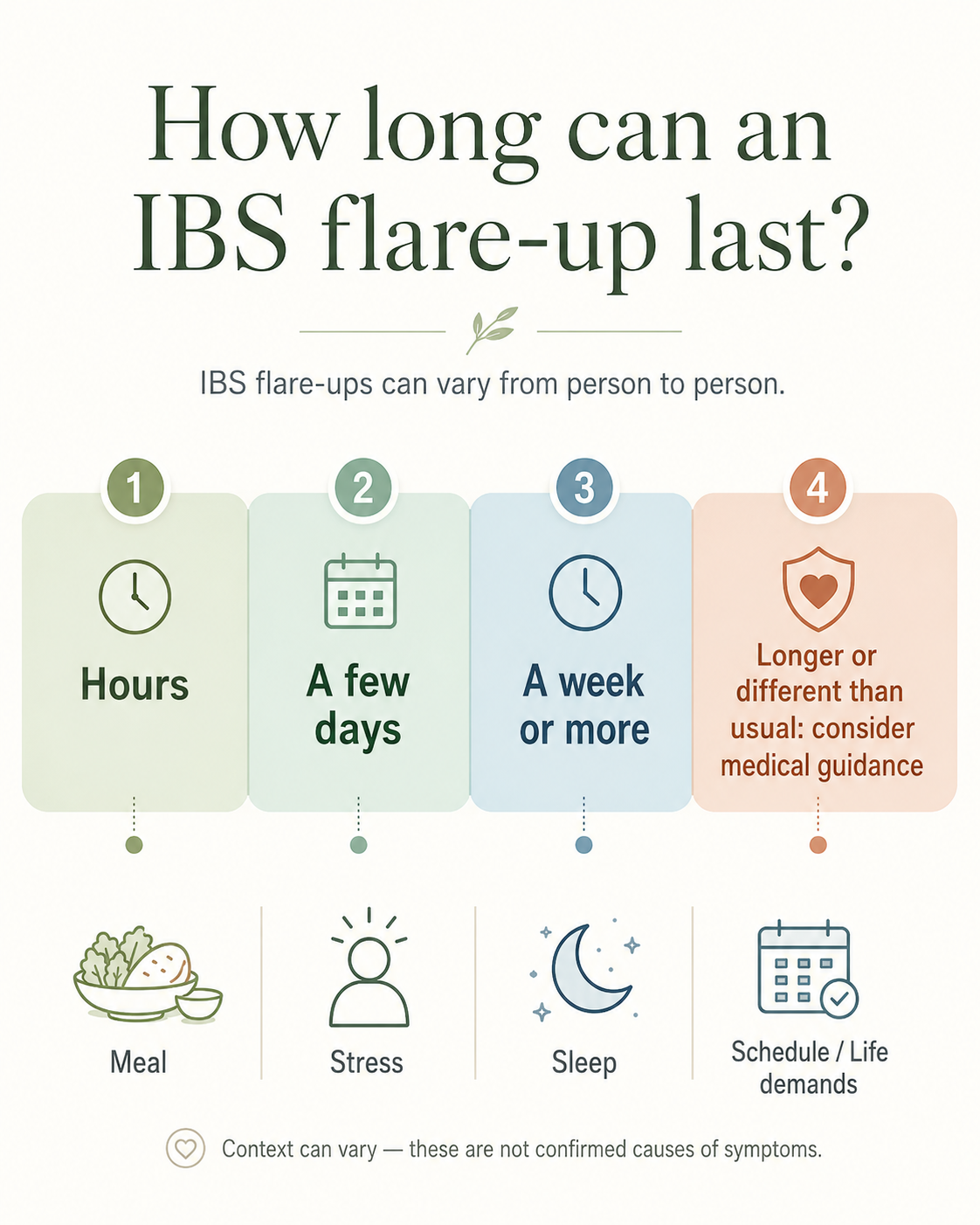
The Short Answer
An IBS flare-up can last a few hours, a few days, or longer. Some people notice symptoms that rise and settle within the same day. Others have symptoms that come and go across several days or weeks.
The reason this question is hard to answer cleanly is that IBS is not defined by one flare length. NIDDK describes IBS as a chronic disorder, meaning it can last a long time, often years, while symptoms may come and go. Common symptoms include abdominal pain related to bowel movements and changes in bowel movements, including diarrhea, constipation, or both. Mayo Clinic also lists cramping, belly pain, bloating, gas, and diarrhea or constipation, or both.
So the better question is not only "How many days can a flare last?" It is also "Does this fit my usual pattern?"
If you usually have short episodes and this one is longer, sharper, wakes you at night, or comes with symptoms you do not normally have, that difference matters. Duration is one clue. Pattern is another.
Why One Flare Can Feel Different From Another
IBS symptoms can be frustrating because they are not always predictable. One flare may seem tied to a meal. Another may arrive during a stressful week. Another may follow poor sleep, travel, antibiotics, a stomach infection, or a period when several things changed at once.
The NHS lists possible flare associations such as alcohol, caffeine, certain foods, stress and anxiety, and regular antibiotic use. NIDDK says IBS may involve brain-gut interaction, gut sensitivity, changes in how food moves through the digestive tract, infections, small intestinal bacterial overgrowth, and food intolerances or sensitivities in some people.
That mix can make flare length feel hard to read. A short episode after one meal may not behave like symptoms that build across a difficult week. Constipation-predominant IBS may feel different from diarrhea-predominant or mixed patterns. Mayo Clinic notes that care often considers IBS subtype, including constipation-predominant, diarrhea-predominant, mixed, or unclassified IBS: Mayo Clinic.
This is why memory alone can be unreliable. When you are uncomfortable, it is hard to reconstruct what changed. A simple log can help you see whether the current flare sits inside a familiar rhythm or stands out from it.
Food May Matter, But It Is Not the Whole Story
Food is often the first place people look during an IBS flare. That makes sense: symptoms can feel closely tied to eating, and the NHS says flare-ups can sometimes have a trigger such as alcohol, caffeine, spicy or fatty food, stress and anxiety, or regular antibiotic use.
Still, it helps to stay careful with the word "trigger." A food that appears near one flare is not proof that it caused the flare. IBS patterns can be noisy. Timing, portions, stress, sleep, menstrual cycle, illness, medication, and recent routine changes can all sit close together.
FODMAPs are one reason food can become part of the conversation. Monash FODMAP explains that FODMAPs are carbohydrates that can draw water into the bowel and be fermented by gut bacteria, and that people with IBS may be more sensitive to those effects. Monash also says people who respond to a low-FODMAP approach usually see symptom improvement within two to six weeks, and recommends doing it with a dietitian or healthcare professional.
Medical sources also discuss other diet approaches. NIDDK says doctors may recommend diet changes for IBS, including more fiber, avoiding gluten, or trying a low-FODMAP diet, depending on the person.
The practical takeaway is not to blame one meal too quickly. It is to gather enough context to have a clearer conversation.
Stress, Sleep, and Routine Can Shape the Pattern
An IBS flare can feel very physical, but the pattern around it may include more than food. That can be validating for people who feel like they have checked every ingredient and still cannot find a simple answer.
NIDDK says lifestyle changes such as increasing physical activity, reducing stressful life situations as much as possible, and getting enough sleep may help IBS symptoms. Mayo Clinic also discusses stress management, fluids, regular exercise, and enough sleep as lifestyle approaches for IBS symptom relief: Mayo Clinic.
There are also mental health therapies that may be discussed in IBS care. NIDDK lists cognitive behavioral therapy, gut-directed hypnotherapy, and relaxation training as therapies doctors may recommend for IBS symptoms. The American College of Gastroenterology guideline discusses gut-directed psychotherapies for global IBS symptoms, while grading the strength and certainty of evidence.
None of this means a flare is "just stress." It means the gut can be sensitive to the conditions around daily life. For some people, the useful pattern is not one food. It is the combination of food, timing, sleep, stress, and stool changes across several days.
When to Get Medical Guidance
A flare that lasts longer than expected can be unsettling. The number of days matters, but warning signs matter more.
The NHS says to see a GP if you think you might have IBS and have had symptoms for more than four weeks. It also advises urgent medical help for unexplained major weight loss, bleeding from the bottom or bloody diarrhea, a hard lump or swelling in the tummy, or signs such as shortness of breath, palpitations, and paler skin than usual.
NIDDK says symptoms that may suggest another health problem instead of IBS include anemia, rectal bleeding, bloody stools or black and tarry stools, and weight loss. Mayo Clinic lists warning features such as symptoms starting after age 50, weight loss, rectal bleeding, fever, repeated vomiting, pain that is not related to passing stool, pain that occurs at night, diarrhea that wakes a person from sleep, and iron-deficiency anemia.
If a flare feels familiar, mild, and settles in a pattern you know, tracking it may be enough for the moment. If it is new, unusually intense, persistent, or paired with any red flag symptoms, getting guidance is the safer next step.
How IBS Is Usually Assessed
IBS is not diagnosed from one difficult stomach day. It is assessed through symptom patterns, history, and sometimes tests to rule out other conditions.
NIDDK says doctors diagnose IBS by reviewing symptoms, medical and family history, and a physical exam. A doctor may diagnose IBS when abdominal pain is present with changes related to bowel movements, stool frequency, or stool appearance, and when symptoms follow a time pattern such as at least once a week in the last three months with first symptoms starting at least six months ago: NIDDK.
Mayo Clinic says there is no test that definitively diagnoses IBS, and healthcare professionals may rule out other conditions such as celiac disease and inflammatory bowel disease. NICE says IBS should be considered in adults with abdominal pain or discomfort, bloating, or change in bowel habit for at least six months, with further assessment for red flags.
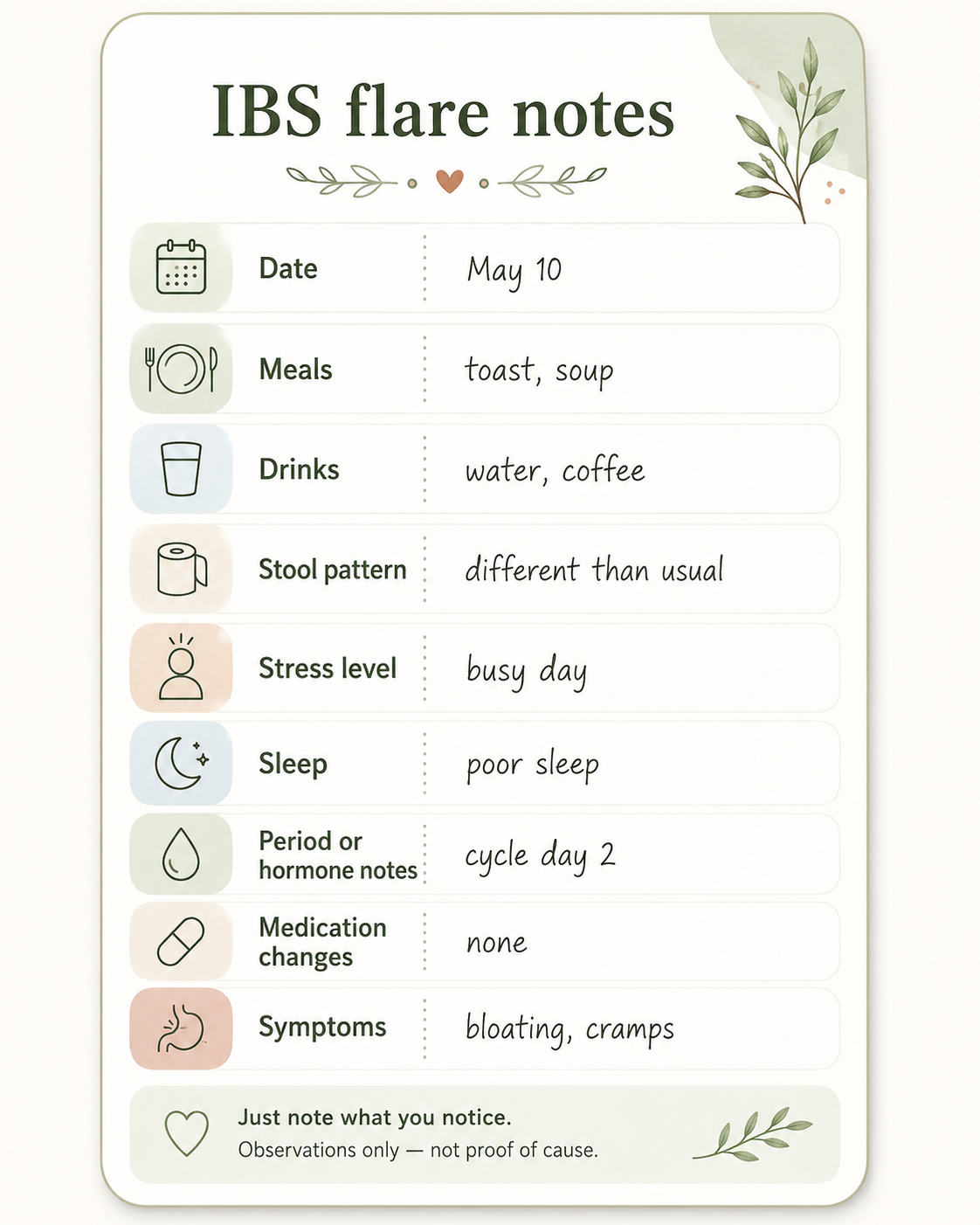
This is another reason a record can help. A log cannot diagnose anything, but it can make the story easier to explain: when symptoms started, how long they lasted, what stool changes happened, what meals were nearby, and whether anything else changed that week.
What May Help During a Flare-Up
When you are in the middle of a flare, it is understandable to want something that makes it end faster. The careful answer is that IBS care is personal, and medical sources discuss several options without promising that one approach works for everyone.
NIDDK says doctors may treat IBS through diet and lifestyle changes, medicines, probiotics, and mental health therapies, and that people may need to try a few treatments to see what works for them with their doctor's help. Mayo Clinic says mild symptoms are often addressed through stress management and diet and lifestyle changes, while moderate or severe symptoms may involve counseling or medicines based on symptom type.
The American College of Gastroenterology guideline recommends a limited trial of a low-FODMAP diet for global IBS symptoms and recommends soluble, but not insoluble, fiber for global IBS symptoms. NCCIH says ACG guidelines recommend peppermint for relief of global IBS symptoms, while noting that evidence quality is low and long-term efficacy has not been established.
These are best treated as topics to discuss with a qualified professional, especially if symptoms are persistent, severe, or changing. The goal is not to guess harder. It is to find a plan that fits the full picture.
A Simple Way to Track Your Own Pattern
If you are trying to understand how long your flares last, keep the log simple enough that you can use it while you feel unwell.
Track the basics:
- when symptoms started and eased
- stool changes, including diarrhea, constipation, urgency, or mucus
- meals and drinks before and during the flare
- stress, sleep, travel, illness, antibiotics, or routine changes
- anything that felt different from your usual IBS pattern
You do not need a perfect record. Even a few notes can help you move from "this keeps happening" to "this was a three-day pattern that started after a week of poor sleep and several rich meals." That kind of detail can be easier to review on your own and easier to bring into a care conversation.
Bottom Line
So, how long can an IBS flare-up last? It can be hours, days, or weeks, and some medically reviewed sources describe longer flare patterns for some people. But the most useful answer is personal: compare the flare with your usual pattern, then check for warning signs.
If the episode is familiar and settles, it may simply be part of your usual IBS rhythm. If it is new, severe, persistent, wakes you from sleep, or comes with bleeding, weight loss, fever, repeated vomiting, anemia signs, or other red flags, do not rely on duration alone. Get medical guidance.
A flare can make your body feel unpredictable. A calm record will not make the uncertainty disappear, but it can give you something steadier than memory: a clearer timeline, a few patterns to review, and better notes for the people helping you think it through.
Sources
- NHS, "Symptoms of irritable bowel syndrome": https://www.nhs.uk/conditions/irritable-bowel-syndrome-ibs/symptoms/
- NIDDK, "Symptoms & Causes of Irritable Bowel Syndrome": https://www.niddk.nih.gov/health-information/digestive-diseases/irritable-bowel-syndrome/symptoms-causes
- NIDDK, "Diagnosis of Irritable Bowel Syndrome": https://www.niddk.nih.gov/health-information/digestive-diseases/irritable-bowel-syndrome/diagnosis
- NIDDK, "Treatment for Irritable Bowel Syndrome": https://www.niddk.nih.gov/health-information/digestive-diseases/irritable-bowel-syndrome/treatment
- Mayo Clinic, "Irritable bowel syndrome - Symptoms and causes": https://www.mayoclinic.org/diseases-conditions/irritable-bowel-syndrome/symptoms-causes/syc-20360016
- Mayo Clinic, "Irritable bowel syndrome - Diagnosis and treatment": https://www.mayoclinic.org/diseases-conditions/irritable-bowel-syndrome/diagnosis-treatment/drc-20360064
- NICE, "Irritable bowel syndrome in adults: diagnosis and management": https://www.nice.org.uk/guidance/cg61/chapter/recommendations
- ACG Clinical Guideline, "Management of Irritable Bowel Syndrome": https://journals.lww.com/ajg/fulltext/2021/01000/acg_clinical_guideline__management_of_irritable.11.aspx
- Monash FODMAP, "About FODMAP and IBS": https://www.monashfodmap.com/about-fodmap-and-ibs/
- NCCIH, "Irritable Bowel Syndrome and Complementary Health Approaches": https://www.nccih.nih.gov/health/providers/digest/irritable-bowel-syndrome-and-complementary-health-approaches-science
- Healthline, "How Long Do IBS Attacks Last?": https://www.healthline.com/health/ibs/how-long-do-ibs-attacks-last
- Medical News Today, "How long does IBS last?": https://www.medicalnewstoday.com/articles/how-long-does-ibs-last